
 English
  Arabic
  Chinese
  French
  German
  Portuguese
  Russian
  Spanish
  Thai
Thai  Vietnamese

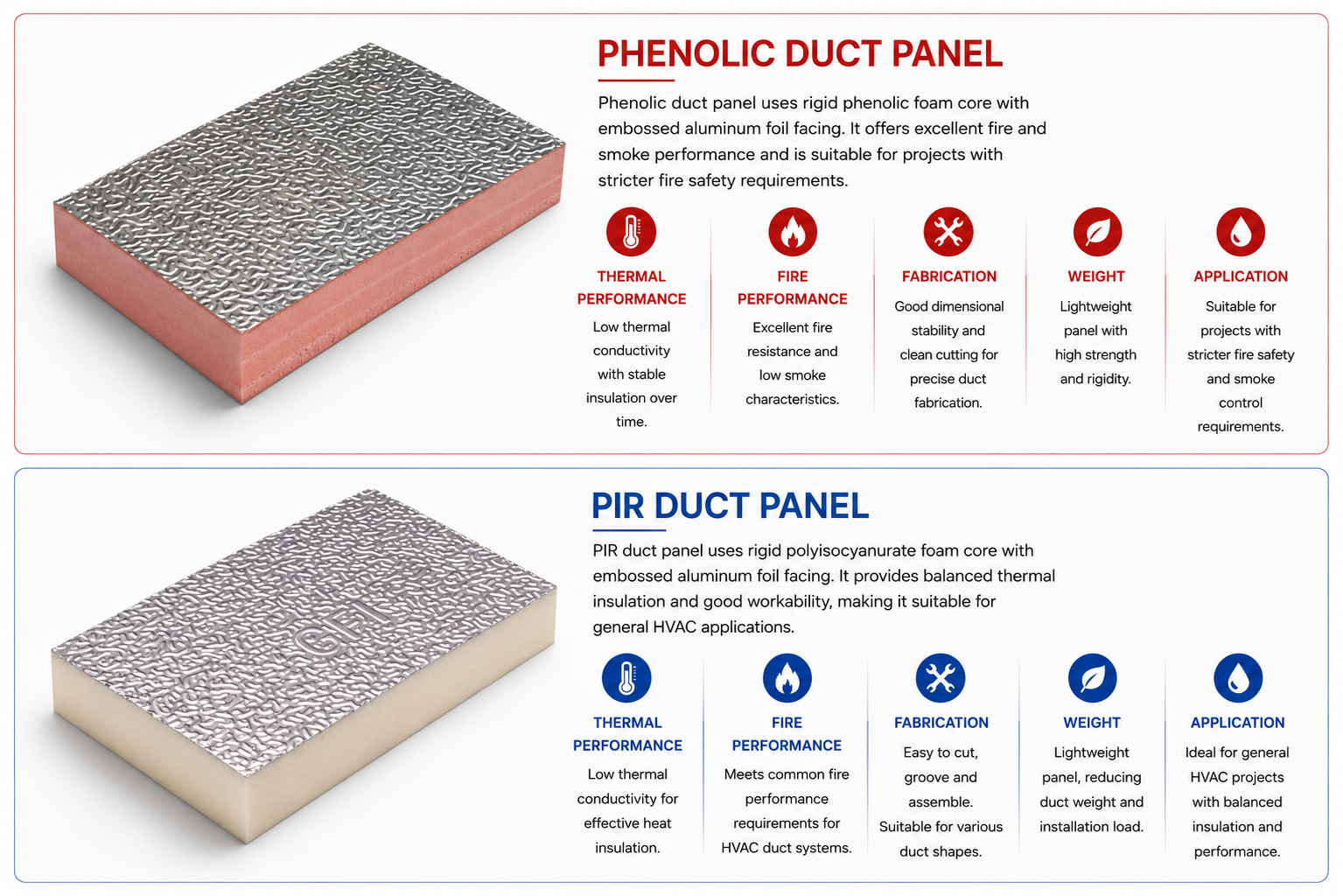
Compare PU/PIR and phenolic pre-insulated duct panels for HVAC projects, including thermal performance, fire behaviour, fabrication and practical selection.
PU/PIR and phenolic panels are both used to fabricate lightweight, pre-insulated HVAC ductwork. Each panel combines a rigid foam core with protective facings, so the duct enclosure and thermal insulation are created in one fabrication process. The finished ducts may look similar, but the core materials do not behave in exactly the same way. The useful question is therefore not which material is universally better, but which tested panel system fits the project requirements.
At-a-Glance Comparison
| Selection factor | PU/PIR duct panels | Phenolic duct panels |
| Core | Rigid polyurethane (PUR) or polyisocyanurate (PIR) | Rigid thermoset phenolic foam |
| Thermal role | High-performance duct insulation; compare exact product data | High-performance duct insulation; compare exact product data |
| Fire and smoke focus | Results vary by formulation and system construction | Often evaluated where verified flame and smoke results are a priority |
| Fabrication | Cut, groove, fold and join as a complete panel system | Cut, groove, fold and join as a complete panel system |
| Selection emphasis | Balance of performance, fabrication and installed cost | Project-specific fire and smoke requirements |
The Four Differences That Matter Most
1. Thermal performance
Both PU/PIR and phenolic foams can provide the low thermal conductivity required for HVAC duct insulation. There is no reliable rule that every phenolic panel insulates better than every PIR panel, or the reverse. Published values are influenced by formulation, density, thickness, test temperature and ageing method. A fair comparison uses the declared value of the exact products at the same test basis and panel thickness. The finished duct also depends on workmanship: gaps, poorly sealed joints or damaged facings can reduce system performance even when the foam core has a strong laboratory value.
2. Fire and smoke performance
Fire and smoke performance is usually the most important point of distinction. Phenolic panels are frequently specified where low flame spread or low smoke development is a major design priority. That does not mean every phenolic product has the same classification, and it does not make the material automatically fireproof. PU and PIR products also vary by formulation, facing and assembly. The correct comparison is between test results for the exact panel constructions being offered. It is also important to separate the reaction-to-fire classification of a panel from the fire-resistance rating of a complete duct assembly; these are different claims and require different evidence.
3. Fabrication and duct stability
Both panel types can be cut, grooved, folded and joined to form rectangular pre-insulated ducts. Actual handling depends on core density, facing strength, bonding quality and panel thickness. Fabricators should evaluate cut-edge quality, groove accuracy, resistance to handling damage and compatibility with adhesives, tapes, flanges and reinforcement components. The core material alone does not determine the allowable duct size or pressure. Those limits belong to the complete system and should be supported by the supplier’s fabrication and reinforcement guidance.
4. Installed system cost
Comparing only the price per sheet can be misleading. The relevant figure is the installed duct cost, which includes panel price, labour, fabrication speed, accessories, reinforcement, transport and expected wastage. A lower-cost board may require more labour or support, while a higher-cost board may be justified by a project-specific performance requirement. Local availability and the fabricator’s experience can also affect the final result.
What to Confirm Before Ordering
Ask the supplier to identify the following for the exact panel being quoted:
- Exact core type: PUR, PIR or phenolic
- Panel thickness and facing construction
- Declared thermal performance and test conditions
- Applicable fire and smoke test reports
- Permitted duct dimensions, pressure and reinforcement method
- Recommended adhesives, tapes, flanges and support spacing
Conclusion
PU/PIR and phenolic duct panels are both valid materials for pre-insulated HVAC ductwork, but they serve different project priorities. PU/PIR is often selected for its balanced combination of insulation, fabrication and cost. Phenolic is often evaluated more closely where verified flame and smoke performance is central to the specification. A sound decision compares the complete panel system, the supporting test documents and the installed cost – not just the name of the foam.
|
Need a panel recommendation for your HVAC duct project? Explore GFI PU, PIR and phenolic pre-insulated duct panels at gfiduct.com |
CONTACT US
Leave us a message and our team will get back to you soon.