
 Chinese
  Arabic
  English
  French
  German
  Portuguese
  Russian
  Spanish
  Thai
Thai  Vietnamese


Cutting Methods for Pre-Insulated Duct Panels
In the production of pre-insulated ducts (PID ducts), the cutting method directly affects product quality, installation efficiency, and overall project cost.
Currently, there are two main cutting approaches in the market — manual cutting and CNC automatic cutting.
Each method has its own advantages and is suitable for different project scales and budgets.
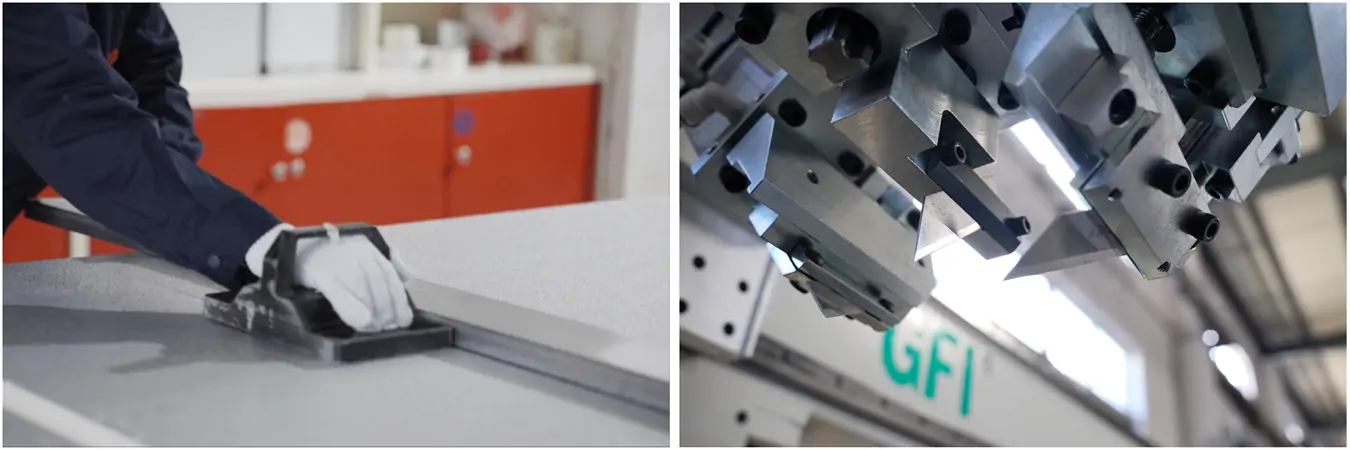
I. Manual Cutting: Flexible but Experience-Dependent
Manual cutting is the traditional and most common method, widely used by small-scale installation teams. It involves marking and cutting PU, PIR, or phenolic duct boards using handheld tools, offering flexibility and low initial investment.
主要特点:
- Low Initial Cost: Only basic cutting tools and labor are required.
- Flexible for Small Projects: Easily adapts to on-site size adjustments.
- Accuracy Depends on Skill: Manual operation can lead to angle or size deviations, affecting assembly fit and air-tightness.
- Limited Efficiency: Complex parts such as elbows, tees, and cross fittings require multiple measurements and repeated cutting.
While cost-effective, manual cutting is less suitable for medium to large projects that demand consistent quality and faster production cycles.

II. CNC Automatic Cutting: High Efficiency and Precision
CNC Pre-Insulated Duct Cutting Equipment uses computer numerical control systems (such as CAMDUCT® software) for automatic design, nesting, and cutting. It supports PU, PIR, and phenolic duct boards, enabling high-precision, large-scale production within a short time.
Main Advantages:
- High Productivity: Cutting speed up to 30 meters per minute significantly improves efficiency.
- Consistent Accuracy: Servo motors and vacuum adsorption tables ensure dimensional stability and reduce rework.
- Fully Automated Operation: Software-generated cutting paths enable straight cuts, bevel cuts, and V-grooves in one process.
- Material Optimization: Automatic nesting minimizes material waste and increases utilization.
- Reduced Labor Costs: One operator can manage the entire cutting process, lowering long-term expenses.
Although the initial investment is higher, Automatic Duct Panel Cutting Equipment achieves cost balance over time by saving labor, increasing production speed, and reducing waste.

III. Choosing the Right Method: Scale and Cost Considerations
- When selecting a cutting method, project scale, accuracy requirements, and production cycle should all be considered.
- Small-Scale or On-Site Projects: Manual cutting offers flexibility and low setup cost.
- Medium to Large Projects or Factory Production: CNC automatic cutting delivers superior efficiency and uniform quality, ideal for standardized manufacturing.
- In the long term, CNC cutting becomes more cost-effective per unit, especially as labor costs continue to rise.

IV. From Cutting to Complete Duct Systems
Beyond the CNC cutting machines, GFI also provides matching PU, PIR, and phenolic pre-insulated duct panels and installation accessories, helping customers build a complete duct fabrication system.
From material supply to automated processing and on-site installation, GFI delivers one-stop solutions that improve overall project efficiency and quality.

结论
Both manual and CNC cutting methods serve important roles in pre-insulated duct fabrication. Manual cutting is flexible and affordable, while CNC Pre-Insulated Duct Cutting Equipment stands out for its speed, precision, and long-term cost efficiency.
As HVAC projects increasingly demand energy-saving and standardized production, automatic cutting solutions are becoming the preferred choice among manufacturers and contractors worldwide.
GFI offers complete pre-insulated ductwork solutions — from high-quality panels to cutting solution and accessories — to streamline your HVAC production.

联系我们
请给我们留言,我们的团队会尽快回复您。.