
 English
  Arabic
  Chinese
  French
  German
  Portuguese
  Russian
  Spanish
  Thai
Thai  Vietnamese


Introduction
Efficient airflow is critical in large commercial buildings to maintain comfort, indoor air quality, and HVAC energy performance. Pre-insulated air ducts — commonly constructed with a rigid polyurethane (phenolic-like) foam core and aluminum foil facing — integrate insulation and duct structure into a single panel. This integration reduces leakage, improves temperature control, and supports steadier airflow over long duct runs compared with traditional metal ducts plus field-installed insulation.

How pre-insulated air ducts improve airflow
- Lower surface friction — the smooth aluminum foil facing reduces internal roughness and pressure loss, allowing air to travel farther with less fan energy.
- Fewer seams and joints — factory-made panels and precision connections reduce leakage points that cause pressure loss and uneven airflow.
- Thermal stability — low thermal conductivity keeps transported air at design temperature, reducing stratification and the need for recirculation or reconditioning.
- Structural stability — rigid panels resist deformation at higher velocities, keeping the HVAC duct cross-section true so air velocity and pressure remain predictable.
These benefits are especially important in large office towers, airports, hospitals, malls and other buildings where long runs, high flow rates and tight space coordination are required.
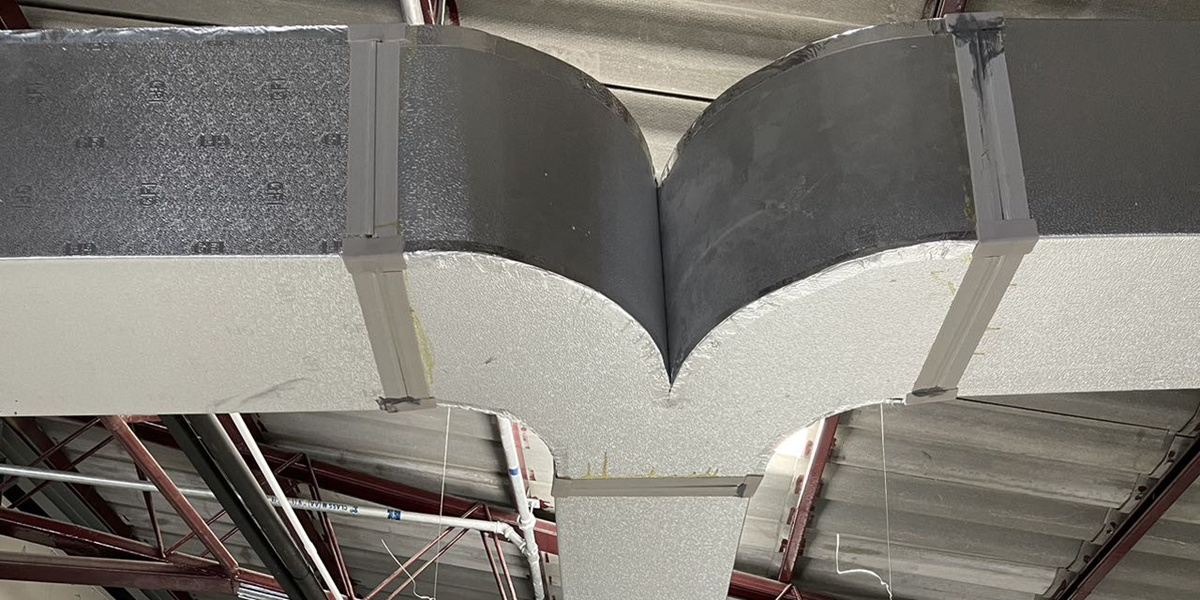
Key technical parameters
| Thickness | 20 / 25 / 30 / 40 mm |
| Foam Density (kg/m³) | 40–50 |
| Aluminum Foil Thickness (micron) | 80 |
| Thermal Conductivity (W/m·K) | 0.02 |
| Fire Rating | BS 476 Part 6 & 7 Class 0 |
| Compressive Strength (MPa) | 0.25 |
| Bending Strength (MPa) | 2 |
| Water Absorption (%) | 0.1 |
| Dimension Change (%) | 0.3 |
| Maximum Wind Velocity (m/s) | 13–20 |
| Maximum Running Temperature (°C) | 80 |
How these parameters relate to airflow and HVAC performance
Below is a practical mapping so spec readers and engineers can see why each number matters for airflow in large buildings:
Thickness (20/25/30/40 mm)
- Thicker panels increase thermal resistance and help control condensation. For airflow, thickness also contributes to overall duct wall depth and acoustic performance; choose thickness based on thermal needs and available shaft/ceiling space.
Foam Density (40–50 kg/m³)
- A consistent density gives stable mechanical properties and a smooth core-to-face bond. Stable panels mean fewer internal irregularities and less risk of surface deformation that could disturb laminar flow in low-turbulence systems.
Aluminum Foil Thickness (80 micron)
- A heavier foil facing improves surface durability and maintains a smooth internal wall—directly reducing friction factor and pressure drop versus rougher faces.
Thermal Conductivity (0.02 W/m·K)
- Low conductivity minimizes temperature change of conveyed air. Stable air temperatures reduce stratification and the need for extra reconditioning, allowing design flows to remain effective over long runs.
Fire Rating (BS 476 Part 6 & 7 Class 0)
- Ensures the system meets strict safety requirements without compromising duct integrity. Fire-rated panels also permit use in critical vertical risers where airflow continuity is required under code.
Compressive Strength (0.25 MPa) & Bending Strength (2 MPa)
- These mechanical properties keep HVAC ducts from collapsing or distorting under mechanical loads or dynamic pressure during high-flow events. A true cross-section preserves designed flow rates and minimizes unexpected pressure losses.
Water Absorption (0.1%) & Dimension Change (0.3%)
- Low moisture uptake and dimensional stability prevent warping or swelling that could create gaps or constrictions—both of which harm airflow uniformity.
Maximum Wind Velocity (13–20 m/s)
- This tells engineers the safe maximum transport velocity the panel system is designed to handle without damage or excessive noise. Designing within this range avoids overstressing the HVAC duct and maintains predicted pressure losses.
Maximum Running Temperature (80°C)
- Defines temperature limits of the transported air. Remaining within this ensures the panel materials keep their structural and surface properties that sustain smooth airflow.

Installation & Handling Notes
- Proper joint assembly and sealing during installation are essential — even small gaps cause measurable leakage and uneven airflow distribution.
- Support spacing should follow manufacturer recommendations to prevent sagging that narrows flow passages.
- Coordinate routing and transitions to avoid unnecessary bends or sudden area changes that increase pressure drop.
Packing and Shipping (GFI)
The length and packaging of GFI Pre-Insulated Duct Panel can be customized. Usually it will be cut and packed as below details:
- 01 / 40’HQ Container: 3950/2950120020mm, 10 sheets packed in one carton, total 660sheets(3950mm) / 880sheets(2950mm).
- 02 / 20’GP Container: 2900120020mm, 10 sheets packed in one carton, total 400sheets.

Applications & design guidance for large buildings
Use pre-insulated panels for long supply trunks, risers, and exposed installations where thermal control, leakage reduction and fast installation matter. When designing for high flows in large buildings:
- size ducts to keep velocities within the recommended 13–20 m/s range for the chosen panel type;
- specify aluminum-faced panels (80 micron) for critical exposed runs;
- select thickness to balance thermal performance and space constraints;
- confirm support spacing and joint methods to preserve cross-section and sealing.
Conclusion
For large commercial HVAC systems, pre-insulated air ducts built to the parameters you supplied offer a strong combination of improved airflow, thermal control, and structural stability. Integrating these panels into system design reduces leakage, holds temperature better across long runs, and maintains predictable pressure and velocity — all essential for reliable HVAC performance at scale.

CONTACT US
Leave us a message and our team will get back to you soon.