
 French
  Arabic
  Chinese
  English
  German
  Portuguese
  Russian
  Spanish
  Thai
Thai  Vietnamese

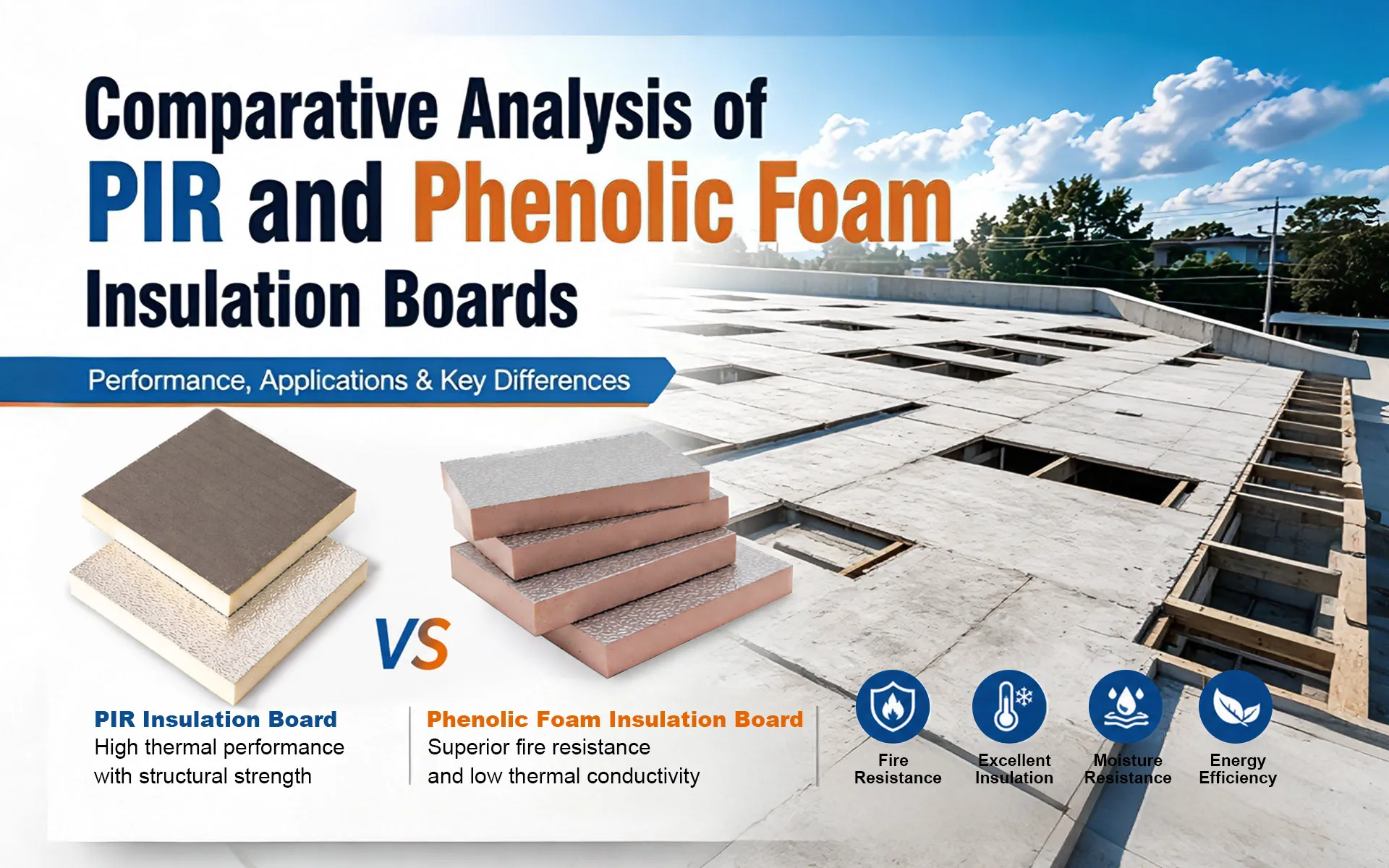
In modern building insulation systems, both PIR (Polyisocyanurate) foam insulation boards et Phenolic foam insulation boards are widely used high-performance thermal insulation materials. They are commonly applied in building envelopes, roofing systems, and industrial enclosures. However, due to differences in material systems and structures, they vary in performance characteristics and application focus.
This article provides a comparative analysis of PIR and Phenolic foam insulation boards in terms of material properties, thermal insulation performance, fire resistance, and application scenarios.

1. Material Structure Differences
Panneau d'isolation en mousse PIR
PIR foam insulation boards are modified polyurethane-based materials. By increasing the isocyanate ratio, a more stable ring structure is formed, thereby enhancing overall performance.
Key characteristics include:
- Good structural stability
- Excellent thermal insulation performance
- High mechanical strength
- Good processing and fabrication properties
Panneau isolant en mousse phénolique
Phenolic foam insulation boards are produced from phenolic resin foaming, featuring a distinct resin-based structure system.
Key characteristics include:
- Strong inherent flame retardancy
- Low thermal conductivity
- Relatively brittle material structure
- Higher processing requirements during manufacturing
2. Thermal Insulation Performance Comparison
In terms of thermal insulation, both PIR and Phenolic foam boards offer excellent insulating performance. Their thermal conductivity typically reaches around 0.02 W/m·K, meeting modern building energy efficiency design requirements.
3. Fire Resistance Performance Comparison
Fire resistance is a critical performance indicator for both PIR and Phenolic insulation boards in building applications.
PIR foam insulation boards demonstrate good thermal stability under high-temperature conditions, delaying decomposition and slowing flame spread. Their fire performance generally complies with standards such as BS 476 Part 6 & Part 7 Class 0, showing stable fire safety performance in building envelope systems.
Phenolic foam insulation boards, due to their resin structure, exhibit strong char-forming ability and flame-retardant performance during combustion. They can achieve multiple international fire standards, including BS 476 Class 0, ASTM E-84 Class A, and UL94-1998 94V-0. Phenolic foam is often selected for projects requiring stringent fire performance specifications, while PIR boards are widely used for balanced thermal, mechanical, and fire performance.
Overall, both materials provide reliable fire safety performance and meet modern building fire rating requirements, each offering advantages under different regulatory systems.

4. Mechanical Properties and Installation Performance
PIR Rigid Foam Insulation Board
- High strength
- Good dimensional stability
- Easy to cut and install
- Strong adaptability in construction
Panneau isolant en mousse phénolique
- Relatively brittle material
- Lower impact resistance
- Higher requirements for installation techniques
- Requires more careful handling during processing
5. Application Scenarios
PIR Foam Insulation Board is mainly used in:
- Building wall insulation systems
- Roofing insulation systems
- Industrial building envelope systems
- Insulated sandwich panel systems
Phenolic Rigid Foam Insulation Board is mainly used in:
- Building envelope systems with high fire safety requirements
- High-standard energy-efficient building façade systems
- Specialized industrial insulation projects
Both materials are high-performance insulation solutions and offer advantages under different engineering standards and design requirements.
Conclusion
PIR and Phenolic foam insulation boards each have distinct characteristics in modern building insulation systems. With continuously increasing requirements for energy efficiency and safety in the construction industry, both materials play important roles in different application scenarios. When selecting insulation materials, engineers should consider fire rating requirements, construction conditions, and structural design needs to achieve an optimal balance between thermal performance and safety.
CONTACT
Laissez-nous un message et notre équipe vous recontactera rapidement.