
 German
  Arabic
  Chinese
  English
  French
  Portuguese
  Russian
  Spanish
  Thai
Thai  Vietnamese


In HVAC systems, noise control is a critical factor for creating a comfortable indoor environment. Both pre-insulated ductwork and galvanized iron (GI) ductwork are widely used in air distribution systems, yet their acoustic properties differ significantly due to structural and material differences.
In modern HVAC system design, noise control is a critical factor alongside energy efficiency and airflow performance. Ductwork, being the primary medium for air distribution, plays a direct role in indoor acoustic comfort. Traditionally, galvanized iron (GI) ducts are widely used, but the growing adoption of pre-insulated ductwork introduces a new dimension in sound attenuation.

Acoustic Principles in Ductwork
Noise in duct systems typically originates from airflow turbulence, mechanical vibrations, and fan operation. When air moves through ducts at high velocity, eddies and pressure fluctuations generate broadband noise, which can be transmitted through duct walls into occupied spaces.
The ability of ductwork to reduce noise depends on:
- Material Density – Heavier materials tend to block sound transmission.
- Surface Absorption – Porous or layered materials absorb airborne noise.
- Vibration Damping – Materials with inherent damping minimize sound radiation from duct walls.
GI Ductwork Acoustic Performance
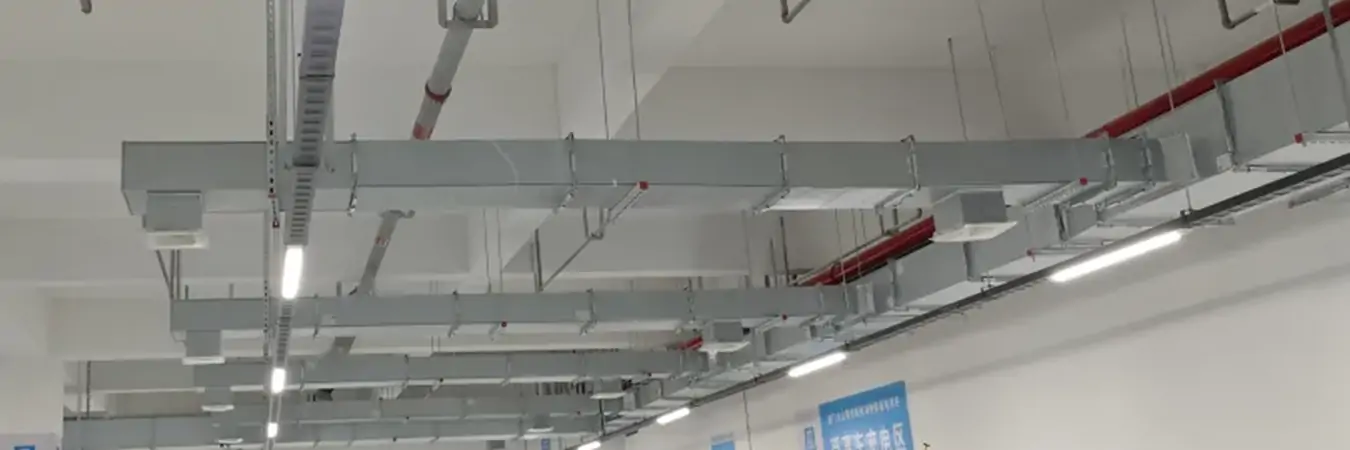
Material Profile: GI ductwork is made from sheet metal, which is rigid and dense but has poor inherent sound absorption.
Noise Transmission: Vibrations generated by airflow or equipment can easily propagate through the metallic surface, resulting in “duct rumble.”
Attenuation Requirement: In most projects, GI ducts require additional acoustic liners or external insulation to achieve acceptable sound levels. These liners are often made of fiberglass or mineral wool.
Maintenance Issue: Internal liners can degrade over time due to airflow erosion or microbial growth, impacting both performance and hygiene.
Pre-Insulated Ductwork Acoustic Performance
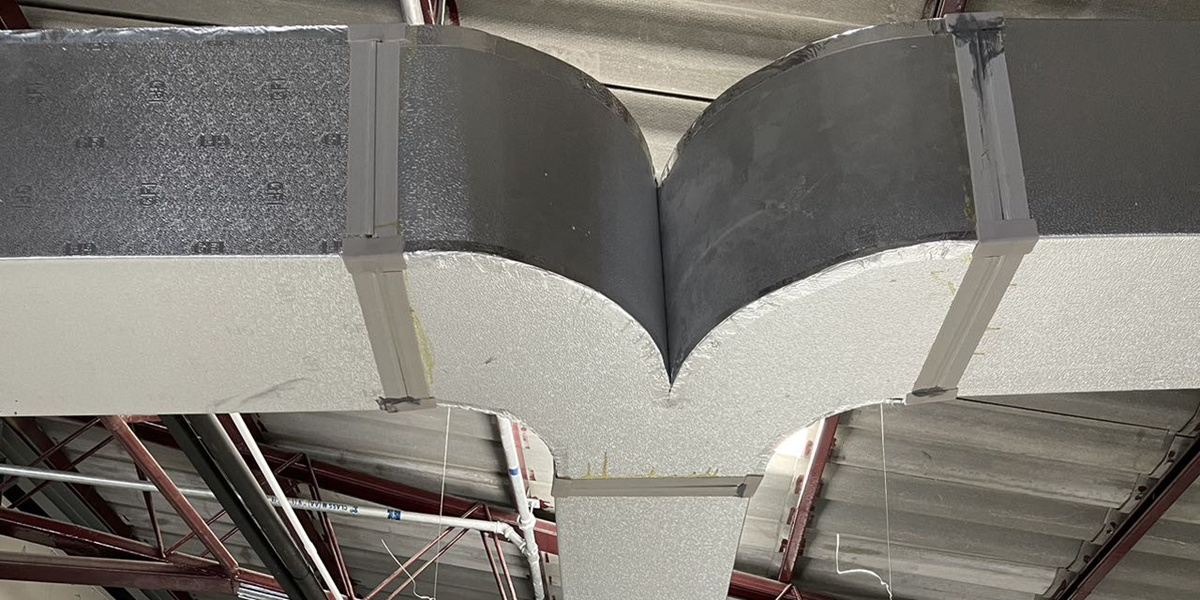
Material Profile: Pre-insulated ducts are typically made of polyurethane (PU) or polyisocyanurate (PIR) foam panels sandwiched between protective facings (e.g., aluminum foil).
Noise Reduction: The closed-cell foam core provides both thermal insulation and sound attenuation, absorbing a portion of airflow noise. The multi-layer structure (foam + aluminum) disrupts vibration transmission better than single-sheet GI ducts.
Vibration Control: Foam panels have higher damping properties, reducing the transmission of structure-borne noise.
Clean Design: Unlike GI ducts with internal liners, pre-insulated ducts maintain smooth, clean interiors, ensuring hygienic airflow without acoustic performance loss over time.
Comparative Analysis
| Aspect | GI Ductwork | Pre-Insulated Ductwork |
| Base Acoustic Property | Low (requires acoustic liners for noise control) | Moderate to High (foam core provides inherent damping) |
| Noise Transmission | High (metallic surfaces easily transmit vibrations and rumble) | Lower (insulation layer significantly reduces sound transmission) |
| Additional Treatment | Requires acoustic liner or external insulation | No extra liner required due to integrated foam insulation |
| Longevity of Sound Attenuation | Performance decreases as liners degrade over time | Consistent attenuation thanks to durable composite panels |
| Overall Acoustic Efficiency | Medium (depends on liner quality and maintenance) | High (stable, integrated sound attenuation performance) |
Abschluss
From an acoustic standpoint, pre-insulated ductwork offers superior sound attenuation compared to GI ductwork, thanks to its foam-core structure and inherent vibration damping. While GI ducts can achieve acceptable noise levels with added liners, pre-insulated ducts provide a built-in acoustic solution, reducing noise transmission without compromising airflow or hygiene.
For projects where acoustic comfort is critical—such as offices, hospitals, and residential buildings—pre-insulated ductwork is a more effective choice in achieving both thermal and acoustic performance goals.
Interested in learning more? Contact us today to get detailed specifications, available sizes, and competitive quotations for our pre-insulated ductwork.
KONTAKT US
Hinterlassen Sie uns eine Nachricht, unser Team meldet sich umgehend bei Ihnen.